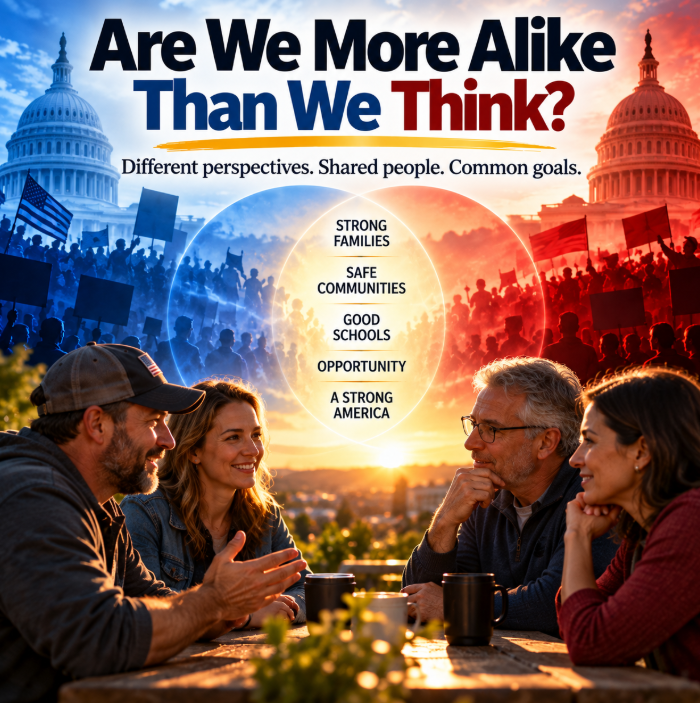
The Double-Slit Experiment: Are We More Alike Than We Think?
What a famous physics experiment can teach us about human behavior, political identity, and the things we believe when nobody is watching
One of the most fascinating experiments in science is the double-slit experiment. It's famous because it challenges our everyday understanding of how the physical world works. But I've been thinking about it for a different reason lately. Not because I believe quantum physics explains human behavior, but because the experiment offers an interesting metaphor for something we see constantly in society, particularly when it comes to politics.
The basic idea is that what we observe can depend on how we measure it. And while human beings certainly aren't behaving according to the same rules as subatomic particles, we do have an interesting tendency to behave differently depending on our environment, the people around us, and whether we believe we're being watched or judged.
Consider how people discuss politics privately compared with how they discuss it publicly. A person might have a thoughtful, nuanced conversation with a neighbor about healthcare, immigration, government spending, or education. They might acknowledge that an opposing argument has merit, admit uncertainty about their own position, or even agree with someone whose political affiliation is completely different from theirs.
Put those same people in front of an audience, particularly one made up of people who share their political identity, and the conversation can change dramatically. Positions may become more rigid, disagreements more pronounced, and the willingness to acknowledge common ground considerably smaller.
Why does that happen? And perhaps more importantly, what does it tell us about how different Democrats and Republicans really are?
The Experiment That Changed How We Understand Observation
In the double-slit experiment, particles such as electrons or photons are directed toward a barrier containing two narrow openings. When the experimental arrangement preserves the possibility of interference, the particles produce a pattern consistent with wave-like behavior. However, when the apparatus measures which opening a particle travels through, that interference pattern disappears.
This is one of the fundamental demonstrations of quantum mechanics. The result isn't caused by a conscious person simply looking at the experiment. It involves the physical interaction between the quantum system and the measuring apparatus, which changes the conditions under which interference can occur.
That's an important distinction because the experiment is frequently misunderstood. It doesn't prove that human consciousness creates reality or that everything changes simply because someone is watching.
Nevertheless, as a metaphor, it raises an interesting question: How much of what we see in human behavior reflects what people actually believe, and how much reflects the environment in which they're expressing those beliefs?
We already know from social psychology that people are influenced by social expectations, group identity, perceived judgment, and the desire to belong. That influence doesn't necessarily mean they're dishonest or lack integrity. It means they're human.
The Person You Meet Versus the Political Identity You See
Imagine two neighbors who have lived next door to each other for fifteen years. One is a Democrat and the other is a Republican. They help each other shovel snow, watch each other's homes during vacations, attend neighborhood gatherings, and occasionally share a beer on the back porch.
They probably agree on quite a few things. They want their families to be safe. They want their children to receive a good education. They want affordable healthcare, financial stability, opportunities for their children, and communities where people can build decent lives. They may disagree significantly about how government should accomplish those things, but many of their underlying concerns are similar.
Now imagine those same neighbors interacting in the comments section of a highly partisan Facebook post. Suddenly, the conversation is no longer simply between two people who know and respect one another. They're speaking in front of an audience. Their political identities are visible, their words may be judged by people on both sides, and every concession risks being interpreted as abandoning their own group.
The environment has changed, and with it, the social consequences of what they say.
That doesn't mean either neighbor has abandoned their principles. It means the conversation now involves something beyond the original issue. It involves belonging, reputation, identity, and the possibility of being rejected by people whose approval matters to them.
We sometimes mistake the behavior people display in those environments for the entirety of who they are.
What the Research Actually Shows
There's some interesting research supporting the idea that Americans share more behavioral similarities than our political conversations might suggest.
In July 2026, Pew Research Center published a study examining how Americans participate in public life, including political activity, community involvement, religious participation, and news consumption. Researchers found that Democrats and Republicans displayed broadly similar patterns of civic engagement, even though their political beliefs differed.
For example, 10% of Republicans and 13% of Democrats fell into the study's most actively engaged category, called Mobilizers. Meanwhile, 28% of Republicans and 23% of Democrats were classified as Outsiders, meaning they participated relatively little in the activities examined.
These aren't identical numbers, but they challenge the idea that one political group is fundamentally more interested in participating in society than the other. Both parties contain highly engaged citizens, moderately engaged citizens, and people who largely stay away from public affairs.
Source: Pew Research Center, July 16, 2026.
Another Pew Research Center study, published October 2, 2026, examined why Americans identify with political parties. The findings were particularly interesting because the motivations expressed by Democrats and Republicans were remarkably similar.
Among Republicans, 72% said a major reason for identifying with their party was believing its policies were good for the country. Among Democrats, the figure was 67%. Meanwhile, 73% of Republicans and 75% of Democrats said a major reason for their party identification was believing the opposing party's policies were harmful to the country.
Think about that for a moment.
Both groups largely believe their preferred party is trying to do something beneficial, while the opposing party represents a threat to the country's well-being. They disagree about which policies are beneficial or harmful, but the underlying motivation is strikingly similar.
Source: Pew Research Center, October 2, 2026.
These findings don't mean Democrats and Republicans secretly agree on everything. They clearly don't. Some disagreements involve deeply held moral principles, competing economic philosophies, constitutional interpretations, and fundamentally different ideas about government's role in society.
But they do suggest something important: We can disagree about what is right while sharing many of the same psychological motivations for believing we're right.
When Political Identity Becomes Part of Who We Are
Human beings have a natural tendency to identify with groups. Those groups might be based on family, religion, nationality, profession, sports teams, communities, or political affiliation.
Group identity provides belonging and a sense of shared purpose. It can also influence how we interpret information and how comfortable we feel expressing disagreement.
Consider what happens when someone criticizes a political position you support. If you see that position simply as an idea, you may be willing to examine the criticism objectively. But if the position has become closely connected to your identity, the criticism can feel personal.
Now you're not simply defending a policy. You may feel as though you're defending your judgment, values, intelligence, or membership in a community.
That distinction matters.
It's possible to be an intelligent, compassionate, thoughtful person and still react defensively when something important to your identity is challenged. It happens in families, workplaces, relationships, religious communities, and professional organizations. Politics is simply one of the most visible places where we observe it.
Social psychologists have studied these dynamics through concepts such as social identity, conformity, motivated reasoning, and social desirability. Each describes a different way our beliefs, judgments, or expressed opinions can be influenced by the social environment.
None of this means people are incapable of independent thought. It means independent thought requires recognizing the pressures that can influence it.
Are We Measuring What People Believe or What They're Comfortable Saying?
This question is especially important when we think about polling, public opinion, and civic engagement.
Imagine asking someone a controversial question in a crowded room filled with people who strongly support one side of an issue. Now imagine asking that same person privately, without requiring them to identify themselves.
Would they give the same answer?
Some would. Others might not.
That difference doesn't automatically mean someone is lying in either setting. A person may genuinely feel conflicted, interpret the question differently depending on context, or be uncomfortable expressing a position that could invite criticism.
This is one reason survey researchers pay attention to how questions are worded, how responses are collected, whether participants feel their answers are confidential, and whether certain groups are less likely to participate.
The environment in which we ask a question can affect the answer we receive.
This matters because we increasingly treat the loudest political voices as representative of entire populations. We watch people argue on television, read hostile exchanges on social media, and assume those interactions accurately represent what millions of Americans believe.
But the people most willing to argue publicly aren't necessarily representative of everyone else.
A person who quietly holds a moderate or complicated position may never enter the discussion. Someone who agrees with parts of both arguments may avoid participating because neither side feels welcoming. Another person may simply have more important things to do than spend an afternoon debating strangers online.
Their silence doesn't mean they don't have opinions. It means we're not hearing them.
The Difference Between Shared Values and Shared Solutions
One of the biggest mistakes we make in political discussions is assuming that disagreement over solutions necessarily means disagreement over goals.
Consider education. Two people may agree that every child deserves a quality education but disagree about school choice, funding formulas, curriculum standards, teacher compensation, or the appropriate role of federal government.
The same thing happens with healthcare. People may share concerns about affordability, access, quality, and medical outcomes while disagreeing about insurance systems, government involvement, regulation, and how those services should be financed.
Immigration provides another example. People may agree that the country needs a functioning immigration system while disagreeing sharply about enforcement, legal pathways, humanitarian responsibilities, and economic consequences.
Recognizing shared concerns doesn't erase meaningful policy differences. Nor does it mean every proposed solution is equally effective or supported by evidence.
It simply changes where the conversation begins.
Instead of assuming someone who disagrees with us wants a completely different outcome, we can ask whether we're trying to solve the same problem through different approaches.
Sometimes we are. Sometimes we aren't. Either way, asking the question gives us a better understanding of the disagreement.
What Happens When We Remove the Audience?
Here's an experiment I'd encourage people to try, although it has nothing to do with quantum mechanics.
Find someone whose political views differ significantly from yours. Preferably someone you know personally and have reason to respect. Have a conversation about an issue you disagree on, but agree beforehand that neither of you is trying to win.
Don't record it. Don't post about it. Don't invite an audience. Don't turn it into a competition where one person needs to prove the other wrong.
Instead, ask questions.
What experiences led you to believe that? What concerns you most about the issue? What outcome are you hoping for? What evidence would make you reconsider your position? Is there anything about the opposing argument that you think has merit?
Then answer those same questions yourself.
You may discover that your disagreements are every bit as significant as you originally believed. That's perfectly acceptable. The objective isn't forced agreement.
But you may also discover that the person you imagined you were arguing with isn't quite the person sitting across from you.
Without an audience, there's less pressure to perform for a group. Without the expectation of winning, there's more room to explore uncertainty. Without the immediate threat of public embarrassment, acknowledging a reasonable point becomes easier.
The conversation can become about understanding rather than defending an identity.
What This Means for Civic Engagement
One of the reasons I founded the American Public Leadership Foundation was my belief that we need better ways to understand what Americans actually care about, particularly between elections.
Traditional political discussions frequently begin with party affiliation. Are you a Democrat or a Republican? Are you liberal or conservative? Do you support this politician or oppose that one?
Those labels can provide useful information, but they can also introduce assumptions before we've asked a single substantive question.
What happens if we begin somewhere else?
What if we ask people to identify their priorities before asking about their political identity? What if we focus on specific issues, provide balanced information, and create opportunities for people to express their views without feeling pressured to defend a political team?
We might discover areas of agreement that are difficult to see when every conversation begins with partisan labels.
We might also identify genuine disagreements more clearly, including disagreements that exist within the same political party.
Neither outcome is a failure. Both provide useful information.
For APLF, this is part of the larger objective of measuring citizen priorities continuously and comparing those priorities with government action. But to do that responsibly, we have to recognize that the way we collect information matters just as much as the questions we ask.
Anonymous participation can reduce some social pressures, but it doesn't eliminate bias. Neutral wording, representative participation, transparent methodology, and a willingness to report inconvenient results are equally important.
If we want to understand Americans, we have to create conditions that encourage them to tell us what they actually think.
Maybe We're More Alike Than We Realize
The double-slit experiment doesn't explain political polarization, and human behavior isn't governed by the same observation effects found in quantum mechanics. But the comparison offers a useful reminder that context matters.
When we observe people in highly partisan environments, we may be seeing behavior shaped by more than their underlying beliefs. We may also be seeing the influence of identity, social expectations, perceived judgment, and the desire to belong.
Take away some of those pressures, and different aspects of the same person may become visible.
That doesn't make political disagreements imaginary. It doesn't mean one side is secretly identical to the other, and it certainly doesn't mean we should abandon our principles simply to get along.
It means we should be careful about assuming that the version of someone we encounter in a political argument represents everything about them.
The Republican arguing passionately about immigration may also be the neighbor who volunteers at a food pantry. The Democrat arguing passionately about healthcare may also be the small business owner worried about rising costs. Both may care deeply about their families, communities, and the future of the country, even when their political conclusions are very different.
Perhaps our biggest mistake is allowing the most confrontational moments of our political lives to define how we see one another.
We are more than our political affiliations. We're parents, spouses, neighbors, veterans, teachers, business owners, volunteers, and members of communities that depend on our willingness to cooperate.
And when we stop treating every disagreement as a test of loyalty, we may discover that understanding one another is considerably easier than the political environment makes it appear.
Maybe the most important question isn't why Democrats and Republicans behave so differently when they're arguing. Maybe it's why we so rarely create opportunities to see how much they have in common when they're not.