APLF Releases a Free Civic Engagement Guide for Local Governments
A practical resource to help governments build stronger, more continuous relationships with the people they serve.
Published: September 2, 2026 | Author: The American PLF Team
Most local governments want residents to participate.
They hold public meetings, publish notices, send surveys, maintain social media pages, and provide opportunities for residents to contact elected officials. Yet despite those efforts, civic engagement can still be difficult. Public meetings may attract the same small group of residents. Surveys can receive limited participation. Important decisions sometimes generate little public attention until after they have already been made.
The result is frustrating for everyone. Government officials may feel that residents aren't interested in participating, while residents may feel that government isn't interested in listening.
The American Public Leadership Foundation believes there is a better way to approach the problem.
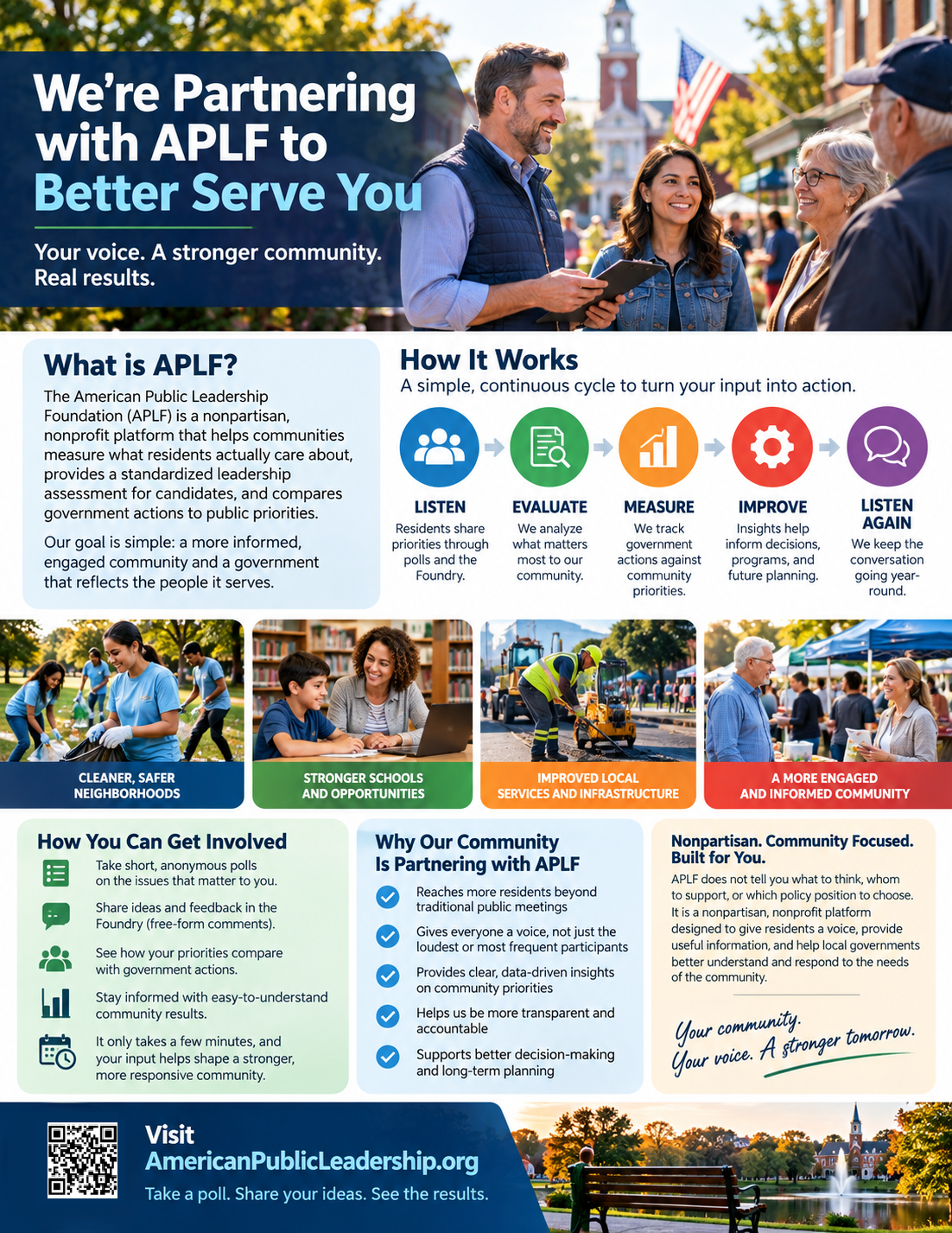
That's why APLF has developed a free Civic Engagement Guide for local governments, designed to help municipalities, counties, elected officials, and public administrators create stronger and more meaningful connections with the communities they serve.
The guide is based on a simple idea: civic engagement shouldn't be something that happens only when government needs public input. It should be an ongoing relationship between residents and their government.
Moving Beyond the Public Meeting
Traditional public meetings remain an important part of local government, but they have limitations. A meeting held at 7:00 p.m. on a Tuesday may work perfectly for one resident and be nearly impossible for another.
Parents may be putting children to bed. Someone may be working a second shift. An elderly resident may not be comfortable driving at night. A younger resident may simply never consider attending a council meeting. Others may care deeply about their community but feel uncomfortable speaking publicly in front of elected officials and strangers.
When public meetings become the primary measure of citizen participation, governments can unintentionally hear from a relatively small portion of the community.
Better civic engagement means creating more ways for people to participate.
That can include online surveys, digital engagement platforms, community events, neighborhood outreach, social media, newsletters, QR codes on government materials, partnerships with local organizations, and other opportunities that allow residents to participate when and where it is convenient for them.
The goal isn't to replace traditional engagement. It is to expand it.
Engagement Should Be Continuous
One of the biggest changes we encourage governments to consider is moving from episodic engagement to continuous engagement.
Too often, residents are asked for their opinions only when a particular issue appears. A government may conduct a survey about a new park, hold a hearing about development, or request comments on a proposed budget. Once that decision has been made, the engagement ends.
But residents' priorities don't remain frozen between surveys.
Economic conditions change. Communities grow. New concerns emerge. Old problems become more or less important. Something that ranked fifth among community priorities six months ago might be the number one concern today.
Governments shouldn't have to guess when those priorities change.
By creating regular opportunities for residents to provide input, local leaders can develop a much clearer picture of what their communities care about over time.
That doesn't mean every government decision should be determined by a poll. Governing requires officials to consider budgets, laws, competing interests, technical expertise, long-term consequences, and many other factors.
Citizen input is one part of that process, but it should be a visible and measurable part.
Reach the People Who Aren't Already Participating
Another major focus of the Civic Engagement Guide is participation breadth.
Getting 500 responses to a community survey sounds impressive until you discover that most respondents come from the same neighborhood or demographic group.
Strong civic engagement isn't simply about getting more responses. It is about hearing from a broader cross-section of the community.
That requires governments to think intentionally about who isn't participating.
Are younger residents involved? Are renters participating alongside homeowners? Are working families represented? Are seniors being reached? Are there neighborhoods that consistently have lower participation? Are residents who don't regularly follow local government on social media even aware that opportunities to participate exist?
Sometimes increasing participation doesn't require an expensive new program. It requires meeting people where they already are.
A QR code on a utility bill can lead residents to a community survey. A recreation department can promote participation at youth sporting events. Libraries can help residents who aren't comfortable using digital platforms. Local businesses, schools, nonprofits, neighborhood associations, and community organizations can help governments reach people who may never visit a municipal website.
The question should no longer be simply, "How do we get people to come to government?"
We should also ask, "How can government go to the people?"
Close the Feedback Loop
Perhaps one of the most overlooked parts of civic engagement happens after residents participate.
Imagine completing a government survey and never hearing about it again. You don't know how many people participated, what the results were, whether officials reviewed them, or whether anything changed because of them.
Eventually, people stop participating.
If governments want residents to continue providing input, residents need to see that their participation matters.
That means closing the feedback loop.
Governments can publish survey results, explain what they learned, identify areas where residents agreed or disagreed, and communicate what actions will follow. When government chooses a different course than public sentiment suggests, officials can explain why.
That last part is important.
Civic engagement does not mean government must always do whatever receives the most votes. Sometimes legal requirements, financial limitations, public safety considerations, or long-term planning require a different decision.
Transparency means showing residents that their voices were heard and explaining how those voices factored into the decision.
A resident who disagrees with an outcome may still have greater trust in the process if they understand how the decision was reached.
Measure Engagement Like Anything Else That Matters
Governments measure budgets, crime statistics, emergency response times, permit processing, infrastructure conditions, and dozens of other indicators.
Why not measure civic engagement too?
How many residents are participating? Is participation increasing or declining? Which neighborhoods are represented? Which issues generate the most interest? Are residents participating repeatedly or only once? Are outreach efforts reaching new people?
Once engagement becomes measurable, governments can begin improving it systematically.
Instead of saying, "We need more people to participate," leaders can identify where participation is weak, experiment with new approaches, and measure whether those approaches worked.
Civic engagement becomes something government can improve rather than simply something it hopes will happen.
Why APLF Created the Guide
The American Public Leadership Foundation was created around a simple belief: citizens should have a meaningful voice in government between elections.
Voting is essential, but Election Day shouldn't be the only time we systematically measure what people want from their government.
Our broader work focuses on measuring citizen priorities, improving civic participation, evaluating public leadership, and creating greater transparency between what communities say they want and what government ultimately does.
The Civic Engagement Guide is one practical extension of that mission.
We also recognize that many local governments operate with limited budgets and small staffs. Improving civic engagement shouldn't require hiring an expensive consulting firm or purchasing a massive technology system before a community can even begin.
That's why we're making the guide available free of charge.
We want local officials, public administrators, community organizations, and residents themselves to use it, share it, adapt its ideas, and begin conversations about how their communities can engage more effectively.
Better Government Starts With Better Communication
Government works better when leaders understand the people they serve, and communities work better when residents understand what their government is doing and why.
Neither happens automatically.
It requires communication, transparency, participation, and a willingness on both sides to listen.
The challenge facing local government isn't simply getting more people to attend meetings. It's creating a culture where participation becomes normal, convenient, measurable, and meaningful.
That means giving residents multiple ways to participate. It means reaching beyond the people who already show up. It means asking for input regularly rather than occasionally. It means reporting back what government heard. And it means showing people how their participation contributed to the process.
Those changes don't require reinventing democracy.
They require making participation easier.
That is what the APLF Civic Engagement Guide is designed to help communities do.
The guide is free because stronger civic engagement shouldn't be limited to governments with the largest budgets.
Every community deserves the opportunity to hear more clearly from the people who call it home.
And every citizen deserves a meaningful opportunity to be heard.
Ready to get started?
Get the Free Civic Engagement Guide